DHS Power G9 vs Yinhe U2: Glass-Carbon and Pure Wood at the Crossroads
These two domestic blades are priced just a few dollars apart, but they represent completely different design philosophies. The Power G9's glass-carbon structure creates a distinct 'dual-personality' feel, while the U2's 7-ply pure wood delivers consistent deformation across all power levels.
The DHS Power G9 and Yinhe U2 sit in the same price bracket—around $33 and $30 respectively—but they answer the question "what makes a good training blade" from completely opposite ends of the spectrum. One adds glass-carbon layers to a wood core; the other strictly sticks to the pure-wood tradition. This isn't a story of which is better. It's a story of deformation: how each blade stores energy, releases it, and "communicates" with your hand at three different power levels.
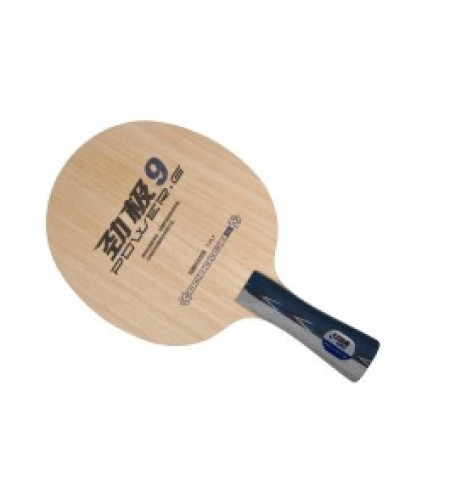
Light Touch: Sensitivity and the "Threshold"
At light touch, the personality differences of both blades are immediately exposed.
Yinhe U2 is clearly the more sensitive tool. Its 7-ply pure wood structure deforms easily under minimal load, giving you clear tactile feedback. The deformation zone is shallow but highly informative—you can actually feel the ball briefly "sink" into the blade before you commit to the return. This "pocketing" characteristic makes U2 highly precise for short-game play: pushes, delicate blocks, and drop shots all benefit from this direct feedback loop. Its activation threshold is very low; the blade starts working almost the moment the ball touches it.
Power G9 tells a completely different story. The glass-carbon layers make it noticeably stiffer, resulting in a much higher activation threshold at light touch. The "pocketing" is compressed—the dwell time feels shorter, and the amplitude feedback is a bit muted. You can still feel where the ball hits, but the deformation is shallower and less communicative. Players used to pure-wood sensitivity might initially describe the Power G9 as feeling "dead" at low power. But this isn't a flaw; it's a deliberate design choice. The blade is simply saving its deformation capacity for when you really need it.
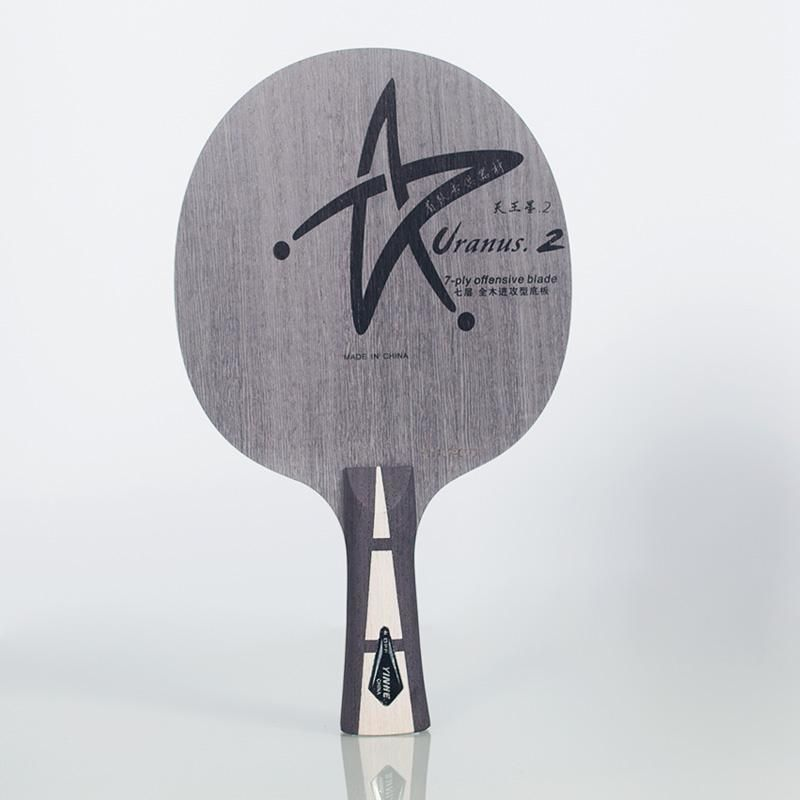
Medium Power: The Watershed of Energy Return
When you step up your power for loop drives and mid-distance exchanges, the two blades take completely different paths.
U2 maintains a steady, linear energy return curve. Deformation deepens in direct proportion to your input force, and the "catapult effect" gradually kicks in. The 7-ply wood structure distributes the load across multiple grain layers, acting like a spring that returns energy smoothly. The longer dwell time helps generate spin—the ball stays on the paddle just long enough for the rubber to fully grip it. During medium-power loops, trajectory control feels stable and predictable. It won't dramatically accelerate the ball for you; it just efficiently returns exactly what you put into it.
Power G9 completely "transforms" at this power level. Once your force crosses its activation threshold, the glass-carbon layers kick in, and the deformation signature changes abruptly. The dwell time gets even shorter, but the energy return disproportionately exceeds your input force. This is the hallmark of carbon-group construction: once loaded, the blade explodes. The catapult sensation is immediate and pronounced—the ball leaves the paddle with a crisp "snap" that pure-wood blades at this price point simply can't replicate. However, this efficiency comes at the cost of spin generation. Less dwell time means the rubber has less time to brush and create rotation. You'll need to adjust your timing, making contact with the ball slightly earlier in its trajectory to match the spin levels of the U2.
Maximum Power: Pure Wood's Ceiling vs. Carbon's Explosion
At maximum power—full-power loops, smashes, and extreme offensive strokes—both blades reach their structural limits, but their peak performances reveal their true colors.
U2 gracefully hits the pure-wood ceiling. As force increases, deformation deepens, but the 7-ply structure holds together coherently. At maximum power, it produces respectable speed and a solid trajectory, though it can't truly "outperform" its pure-wood nature. There's no extra catapult boost; the return is honest and proportional. For intermediate players who prioritize consistency over explosive power, this ceiling isn't a limitation—it's a highly reliable platform.
Power G9, on the other hand, shows exactly why carbon-group construction dominates at advanced levels. At maximum power, its "elastic reserve" is completely drained, delivering speeds that far surpass the U2. The trajectory becomes flatter and more penetrating. The catapult effect reaches its peak—the blade literally releases the ball faster than your swing speed alone could generate. But there is a catch: its effective sweet spot becomes much narrower. If you miss the optimal contact point, the shot quality drops off a cliff. At extreme power, this blade demands extreme precision. Off-center hits are actively punished with less spin and inconsistent trajectories, making it far less forgiving than the U2.
Conclusion: Which "Muscle Memory" Do You Want to Build?
Neither path is superior; they just lead to different destinations.
Yinhe U2 teaches you through feedback. Its pure-wood deformation constantly communicates with you, rewarding patience with dwell time and helping you build your technique around consistent rubber-to-ball contact. It offers a forgiving margin for error, meaning your mistakes won't be catastrophically amplified.
Power G9 teaches you through efficiency. Its glass-carbon structure forces you to consciously push past its activation threshold, match your timing to a shorter dwell window, and exploit its explosive catapult. The challenge here is different: it's about precise timing and power management, rather than interpreting tactile feedback.
When choosing between them, don't just assess your current skill level. Ask yourself what kind of "physical vocabulary" you want to develop. Do you want delicate touch and high forgiveness, or crisp explosiveness and ultimate speed?
© 2026 PaddleWiz. All rights reserved.
This article may not be reproduced or redistributed without proper attribution to PaddleWiz.
Find Your Perfect Paddle Setup
Answer a few questions and get a personalized blade + rubber recommendation.
Try PaddleWiz →